Industry
Part of Critiques of social media: six families, tests and cases
Getting critiques of social media risks right the first time
A method for critiques of social media risks: name the mechanism, scope the claim, identify a remedy, and state what would change your mind.
Criticism of a medium is not a free action. A critique can be wrong, the obvious risk, and it can also be right and still do damage.
It can take space a better complaint needed, supply a shape anyone can fill with any target, or describe a harm in enough detail to teach it.
This page is about critiques of social media risks themselves rather than whether any particular criticism is correct. Getting the reasoning wrong is how an argument about a medium can end up producing nothing usable.
What to take away
- The recurring failure is the panic shapea real concern, an unbounded claim, a demand for action, and no way to be wrong.
- A critique that cannot specify what would change its mind is not a claim, and it cannot be built on.
- Detailed descriptions of a harm are instructions, whatever the intent, and the more vivid the account the more it teaches.
- Displacement is the quiet costattention is finite, and a dramatic complaint crowds out a duller one that had a remedy.
The panic shape
Every medium in turn gets an argument with the same structure, and recognizing the structure is not the same as dismissing the concern. The concern is often real. The structure is what makes it unusable.
The panic shape
- A real case: something genuinely bad happened
- Generalization without a rate: happening everywhere
- Mechanism asserted, not shown: medium causes it
- Urgency: no time to establish properly
- No falsifier: nothing counts as evidence against
| Beat | What it sounds like | Why it fails |
|---|---|---|
| A real case | Something genuinely bad happened | Fine, and it is one case |
| Generalization without a rate | This is happening everywhere | No denominator, so nothing can be compared or checked |
| A mechanism asserted, not shown | The medium causes it | The mechanism is plausible and unevidenced, and plausibility is doing the work |
| Urgency | There is no time to establish this properly | Urgency is exactly the condition under which bad remedies pass |
| No falsifier | Nothing would count as evidence against | At this point the claim has left the category of claims |
The literature on this pattern, under moral panic, includes Stanley Cohen's Folk Devils and Moral Panics (1972), which analyzes reactions to the Mods and Rockers, and Stuart Hall et al.'s Policing the Crisis: Mugging, the State, and Law and Order (1978). These works are not debunking frameworks. They describe how a real problem gets processed into an unusable form, which can happen to true concerns as readily as to false ones.
Earlier media cases make the comparison concrete, not universal. Fredric Wertham's Seduction of the Innocent (1954) and the U.S. Senate's 1954 hearings on comic books are named examples of the comic-book controversy. Their existence does not prove that all warnings about new media are false; each case still requires its own evidence and proposed mechanism.
Social media examples
A more testable critique names a company, product, and evidence. At the U.S. Senate hearing “Protecting Kids Online: Testimony from a Facebook Whistleblower” on October 5, 2021, Frances Haugen presented internal company documents and discussed Facebook's research on Instagram and teen girls' body image. This is more specific than saying “social media harms teens,” though the testimony does not by itself establish that all social media use causes harm.
An example of a critique done wrong is the unqualified claim “social media causes teen depression.” Do not attribute that shorthand to Jonathan Haidt's The Anxious Generation (2024): his book's argument about smartphone-based childhood is broader, and the shorthand erases distinctions among platforms, features, populations, and evidence. To make the claim testable, name the service and feature, define the group, and say what evidence would count against it.
A worked critique
Haugen's testimony is an investigative lead, not proof of a causal effect. The following example shows how to turn that lead into a testable critique:
- Claim:Instagram's recommendation system may repeatedly expose teen girls to appearance-focused content, contributing to body-image distress. Treat this as a hypothesis, not an established finding.
- Mechanism:Repeated exposure is the proposed pathway; distinguish it from total time spent online or generic social media use.
- Scope:Teen girls using Instagram during a defined study period, with exposure and outcome measured separately—not all teens or platforms.
- Remedy:Specify what recommendation change could reduce the proposed exposure, then assess whether it does.
- Falsifier:The pathway is weakened if exposure does not precede distress, or if a credible change that reduces exposure does not alter the outcome. Account for baseline distress and other plausible explanations.
Two further test cases show how to name a feature and mechanism without presenting an unverified result: TikTok's For You recommendations could be tested for whether they repeatedly surface appearance-focused content to a defined teen group; YouTube autoplay could be tested for whether it prolongs exposure to distressing material after a viewer intends to stop. These are hypotheses, not findings. Each needs a defined population and period, an exposure measure, plausible alternative explanations, and a result that would count against the claim.
For claims about prevalence or change over time, require a dated rate with a numerator and denominator. Testimony or a vivid example cannot supply one; if the evidence is unavailable, label the claim unquantified and narrow its scope.
For a governance example rather than causal evidence, the EU's Digital Services Act (DSA) offers a comparison outside the U.S.: risk assessment, mitigation, and audit are core components of its governance framework.
Displacement
Attention to criticism is finite. A dramatic complaint with no remedy uses the same attention a specific, fixable problem needed, and the specific one loses because it is duller.
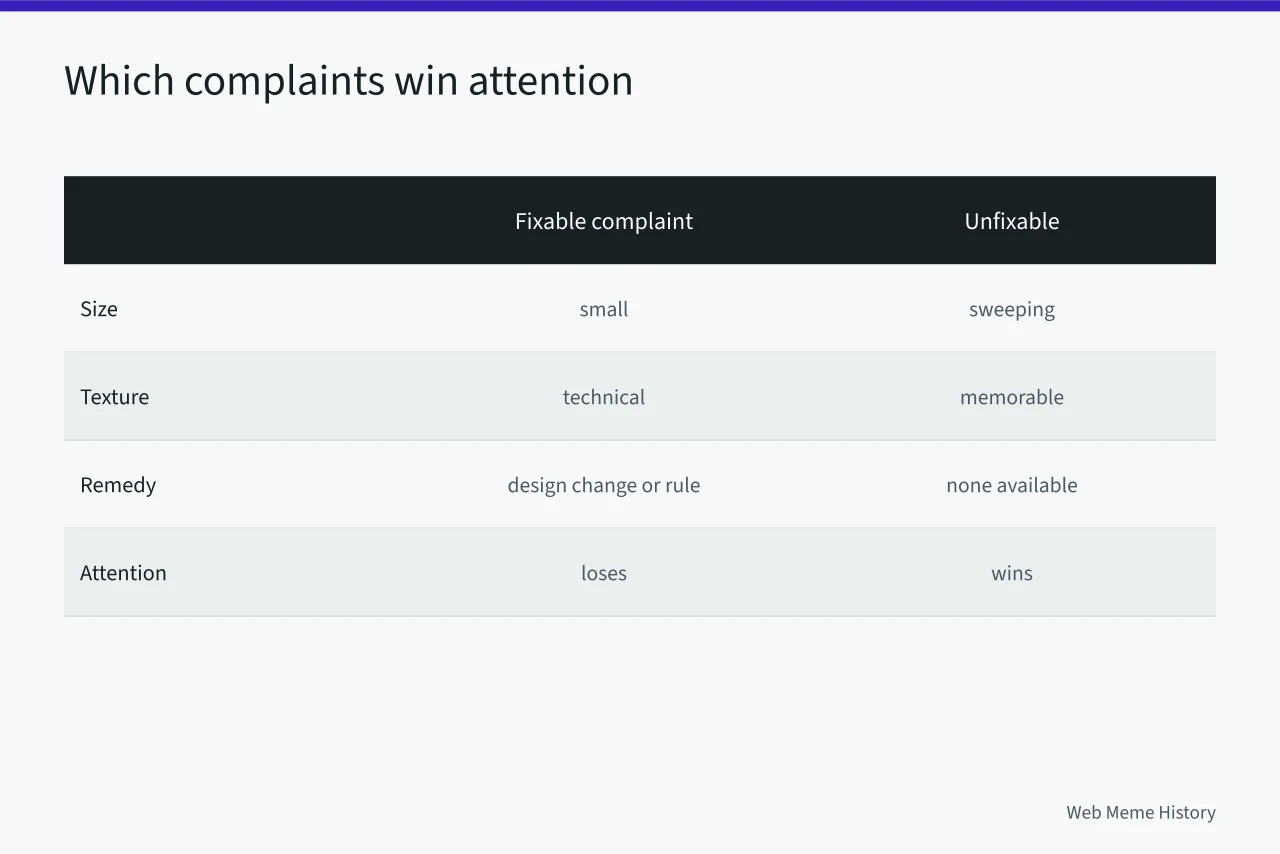
This is the least visible cost and probably the largest. Complaints that a design change or rule can address tend to be small, technical, and unexciting.
Use a simple sorting scheme before amplifying a complaint: (1) a service-specific design or policy problem with a plausible remedy; (2) a group or social dynamic that may persist without the service; or (3) a broad claim whose target, mechanism, or remedy is unspecified. Ask who can change the condition and what evidence would move the complaint into another category; the critiques of social media guide is supplementary, not a substitute for those questions.
The template problem
A critique that spreads is a critique that is easy to copy, and easy to copy means the target slot is loose. Once an argument has a portable shape, it gets applied to whatever the person using it dislikes, with the original evidence still attached in readers' memories but no longer relevant.
The same copying dynamic that runs formats, explored in memes and virality, applies to arguments. A well-made critique of one specific thing can become a general-purpose accusation, while the original evidence remains in readers' memories but no longer applies.
The defense is to build the specificity into the claim rather than the surrounding text. A sentence that names the mechanism and its conditions is harder to repurpose than a sentence that names a feeling. Conditions are what make a claim portable in the useful sense and unportable in the damaging one.
Describing a harm without teaching it
Some critiques require describing what goes wrong. The problem is that a description detailed enough to be persuasive is usually detailed enough to be a method, and the vividness that makes an account convincing is exactly the part that teaches.
Working rules:
- Describe the shape and the conditions, not the steps. A reader can understand why something works without learning how to run it.
- Name what makes a target vulnerable at the level of a property, not a procedure.
- Do not reproduce the material. Quoting an example to condemn it distributes it further, with your audience added.
- Avoid details that identify or expose a vulnerable private person. The Streisand effect is a mild illustration of how attention can magnify exposure; naming a company or public official when needed to substantiate a claim is different from amplifying a private target.
This costs something. Accounts written to these rules are less gripping and persuade fewer people, and that is a real trade rather than a costless virtue. It is still the right trade, because the people who would be harmed by the vivid version are not the people making the decision.
What a durable critique does differently
- It states a mechanism, with the conditions under which it operates.
- It says what would count as evidence against it, before anyone asks.
- It scopes the claim to a population and a period, rather than to the medium in general.
- It separates the part somebody could fix from the part nobody can, so the argument has somewhere to go.
- It tests the no-company counterfactualwould the same harm persist without this service or feature? If so, group dynamics may be doing the work; if not, a service-specific mechanism needs evidence. The internet communities page offers further context, but this counterfactual is the test.
Critiques built this way age well and get cited by people who disagree with them. That is the practical measure. Critiques built the other way get quoted for a season, then become embarrassing and take the concern down with them.
The same discipline applies to claims about a platform's history: record what changed, when, what source establishes it, and what remains uncertain, as in platform timelines.
Common questions
Is caution here just a way of protecting the services?
It can be used that way, and the answer is not to be less careful but to be specific enough that the criticism cannot be waved off. Vagueness is what lets a complaint be dismissed.
What if the harm is urgent and the evidence is not in?
Say both. An honest urgent claim states what is known, what is suspected, and what would settle it. Urgency is a reason to act carefully, not a reason to skip the second half.
Does this apply to defending these services too?
Entirely. The optimistic version has the same failure modes: one good case, generalized, with a mechanism asserted and no falsifier attached.
How do I know if my own complaint has the panic shape?
Try to write the sentence that would change your mind. If you cannot, the shape is present, and that is worth knowing before anyone else points it out.