Guides
Part of Benefits of social media, in six rules: how to test any claim
Social media view counts: what the number actually includes
Social media statistics explained: what a view can mean, why deduplication decides everything, and how to write a count down without overclaiming.
A large number under a post looks like a measurement. It is better understood as an artifact: a figure produced by an interested party, using a definition it is not obliged to publish, counting an event it gets to define, over a window it chooses.
None of that makes the number useless. It makes it a fact about the platform's accounting rather than a fact about how many people saw something.
What to take away
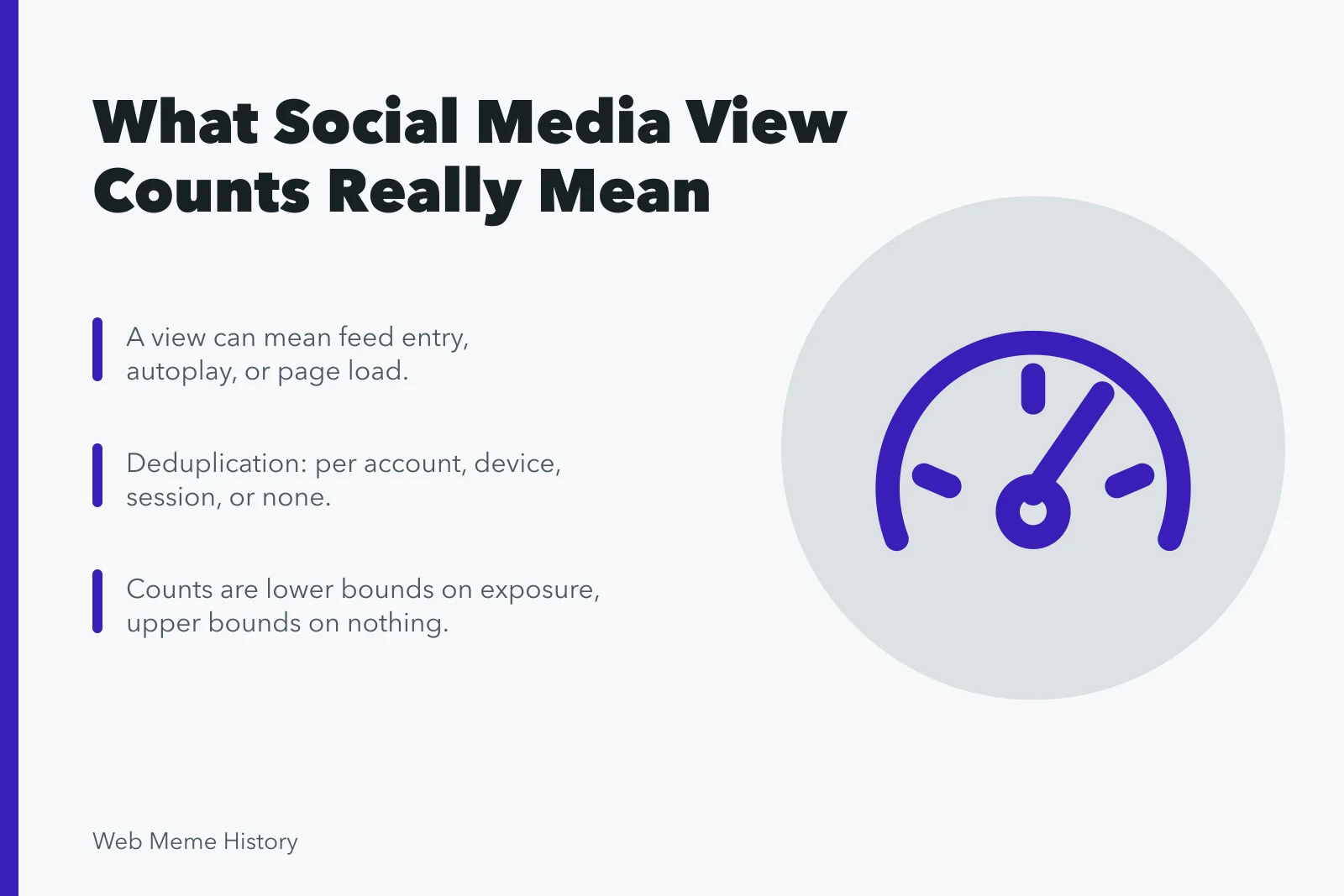
- Every count is a lower bound on exposure and an upper bound on nothing.
- Interaction counts collapse approval, disagreement, mockery, argument and accident into one figure.
- Report it as an observation with an owner and a date: the count that a named surface displayed on a stated day, as measured by that platform.
What "a view" can mean
Services lack a shared definition of a view, and they do not need one. A view may count when the item enters a feed's visible area.
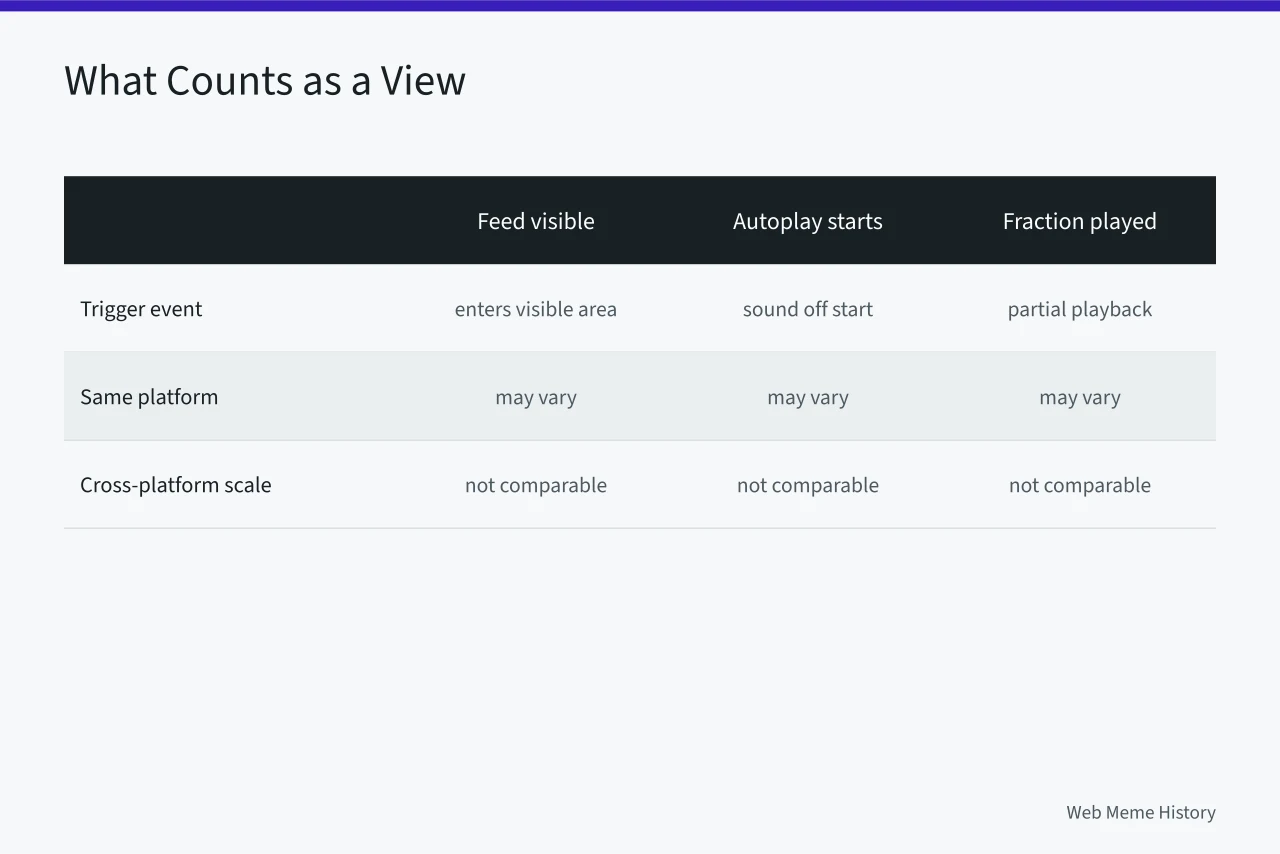
It may also count when playback starts automatically with sound off, when a fraction has played, when playback passes a threshold, or when the page loads. One service can use several in different places in its own interface.
The practical consequence: two counts from two platforms are not on the same scale, and a ratio between them means nothing. Before repeating a view figure, find out what event it counts. If that is not published, say so when you quote it.
Deduplication decides everything
The same definition produces wildly different totals depending on whether repeats are collapsed. Counting per account, per device, per session, or not at all are four different measurements. Autoplay and looping magnify the gap: a short item that repeats can accumulate counts from a small number of people who never chose to watch it once.
Ask whether a figure is of events or of people. If nobody can tell you, treat it as events.
The part that cannot be counted at all
Every count is a lower bound on exposure and an upper bound on nothing. What escapes the counter:
- Screenshots, which circulate as new images with no link back.
- Re-uploads, which start fresh counters on other accounts and other services.
- Forwarding into private messages and group chats, where nothing is measured.
- Copies passed offline entirely: shown on someone's phone, printed, put on a wall.
- Copies inside closed services that publish nothing.
What becomes of the copies that escape the counter, and why none of the surviving collections holds them either, is set out under internet culture archives.
The way a single format produces many uncounted copies is the subject of memes and virality. A format can be genuinely widespread while every individual public copy shows a modest number, because the spread happened where nothing counts. This is why counts are poor evidence about culture even when they are honest.
Engagement is not audience, and audience is not agreement
Interaction counts collapse approval, disagreement, mockery, argument and accident into one figure. A post that people share to condemn it registers identically to one people share because they like it. Reading engagement as endorsement is the single most common error in writing about online popularity.
There is also a feedback loop: in ranked feeds, an item that performs well gets shown to more people because it performs well. Part of any large number comes from the number itself, not the item.
Counts are not independent evidence of appeal; they partly show that an item was promoted, which a ranked attention economy produces by construction.
Survivorship
You only ever see the attempts that worked. This is survivorship bias in the form that does the most damage here, because the losing attempts are not merely unrecorded, they are unrecorded by design.
The denominator is invisible: how many similar things were posted and went nowhere. Usually the poster cannot see it either. Any claim that "this kind of thing succeeds" needs that denominator and almost never has it.
Without it, you see winners and infer a rule. A platform's structure decides which winners ever reach a feed, the argument in benefits of social media platforms.
Questions to ask before you quote a figure
| The figure you are given | The question that decides whether it means anything |
|---|---|
| A view or play count | What event is counted, and is it deduplicated? |
| Followers or subscribers | Over what period were these accumulated, and are inactive accounts included? |
| A share or repost count | Does it include shares of shares, and does it include private forwards? |
| A percentage | Percentage of what base, defined how? |
| A growth figure | Same definition at both ends, or was the metric redefined in between? |
| A ranking or chart position | Ranked against what pool, on what measure, over what window? |
| An estimate from a third party | Modeled from what inputs, and validated against what? |
How to write a number down honestly
Report it as an observation with an owner and a date: the count a named surface displayed on a stated day, as measured by that platform. That sentence stays true forever.
It is the same discipline for a personal counter under online status and identity. "The item was seen by that many people" was never true and will be embarrassing later.
Where you need a current figure, point the reader at where to look it up rather than freezing a number into a page. Counts move, get revised, and occasionally get reset; a page that names the source and the method ages better than one that names a total.
For the related problem of putting two platforms' figures side by side, see benefits of social media comparison. For the pillar overview, see benefits of social media.
Common questions
If counts are this unreliable, why does anyone use them?
Because they are consistent enough within one account on one platform to show change over time. That is a real use. It just is not the use most articles put them to.
Are third-party estimates better than platform figures?
They are differently flawed. They avoid the conflict of interest and add modeling assumptions you usually cannot inspect. Prefer whichever one publishes its method.
How should a historical count be treated?
As a snapshot of a display, not of reality, and only if it was captured with the surrounding interface. A number quoted from memory or from an uncaptured screenshot is not recoverable evidence.